
What is a SWIFT/BIC code?
A SWIFT/BIC code is a code used to identify a bank, or a specific branch of a bank, for international payments.
- It is either 8 or 11 characters long, made up of letters and numbers.
- It is sometimes called a SWIFT code, BIC, or SWIFT/BIC. They all refer to the same code.
- It is similar to a BSB in Australia, but it works between countries instead of within one country.
- A SWIFT/BIC code identifies the bank, not the account. You will normally also need an account number or IBAN.
What does the code mean?
A SWIFT/BIC code is made up of a few parts. For example, CTBAAU2S:
- The first 4 letters are the bank code (CTBA = Commonwealth Bank of Australia).
- The next 2 letters are the country code (AU = Australia).
- The next 2 characters are the location code (2S = Sydney).
- The last 3 characters (when shown) are the branch code, which points to a specific branch.
This is shown so you can recognise the parts of a code. You don't need to memorise it.
The country code (the 5th and 6th characters) must match the recipient's bank country. For example, a UK bank's SWIFT/BIC always has "GB" in those positions, and a US bank's always has "US".
8-character and 11-character codes
- An 8-character code refers to the bank's head office.
- An 11-character code refers to a specific branch of the bank.
- A SWIFT/BIC can be 8 or 11 characters long. When you enter the code in Send, we show the bank name and country it matches.
- If you are unsure whether the code should be 8 or 11 characters, confirm it with the recipient or their bank before continuing.
Where to get the SWIFT/BIC code
Your recipient is the best person to provide this code. If they aren't sure where to find it, common sources include:
- Their online banking. In the account details section, often under headings such as "International payments" or "Receive money from overseas".
- A recent account statement. Near the bank's address or contact details
- The bank's official website. On its international payments page, in its FAQs, or in the website footer. Use the bank's official website rather than third-party search results.
- If they're unsure, they can contact their bank to confirm.
- You may not always be asked for a SWIFT/BIC. For some destinations, Send may ask for a different code instead (for example, a Sort Code in the UK or an ABA routing number in the US). The Send portal will tell you which fields are needed when you add the recipient.
How to add a recipient's SWIFT/BIC
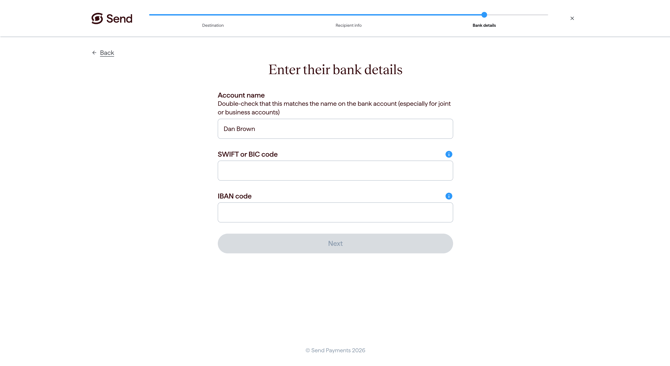
Step 1: Open the "Enter their bank details" screen
When you create a new recipient in Send, the last step is Enter their bank details. The SWIFT/BIC field will appear if it's required.
Step 2: Enter the code into Send
Type the SWIFT/BIC into the SWIFT/BIC field.
- Don't add spaces or dashes.
- When you enter a recognised code, Send will show the matching bank name and country below the field.
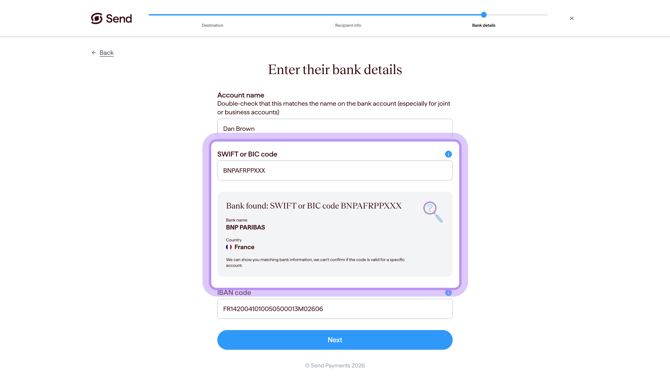
Step 3: Check the codes match
Before continuing, check that the bank name and country shown match the recipient's bank. If they don't, double-check the code with the recipient.
What happens next
When you enter a SWIFT/BIC code on Send, we check it in two quick steps:
- First, we check the code is in the right format as you type.
- Once the format looks correct, we check the code against a list of known banks and show you the bank name and country it matches.
- Check that the bank name and country shown match your recipient's bank. If they don't, double-check the code with the recipient.
- If the code is in the wrong format, or doesn't match a known bank, you'll see the message: "Oops, please check the format and try again". You won't be able to continue until a recognised code is entered.
Common issues
My payment was returned or refunded
A returned or refunded payment can happen for different reasons, including incorrect recipient bank details.
- Check the SWIFT/BIC and other recipient details with the recipient or their bank.
- If the payment has been returned, contact our support team for help with next steps.
My recipient's bank doesn't have a SWIFT code
If the recipient cannot provide a SWIFT/BIC code, contact our support team. We can help you understand what details are needed to send the payment.
I only have an 8-character code but the form asks for 11
If you are unsure whether the code should be 8 or 11 characters, confirm it with the recipient or their bank before continuing.
The SWIFT code I found online doesn't match what's on the statement
- Use the SWIFT/BIC code confirmed by the recipient or their bank.
- A bank may have more than one SWIFT/BIC code (for different branches or services), so the recipient's bank can confirm which one applies to their account.
Is the SWIFT code the same as a routing number, IBAN, or BSB?
No. They identify different things:
- A SWIFT/BIC code identifies the bank, internationally.
- An IBAN identifies the specific account (used in Europe and many other regions).
- Routing, sort, and BSB codes are domestic codes used inside one country.
For some international payments you may need a SWIFT/BIC code together with one of these other codes.
SWIFT/BIC vs other bank codes
Different countries use different codes to identify a bank or an account. A SWIFT/BIC code is one of many. Here is how it compares:
- SWIFT/BIC identifies the bank, internationally.
- IBAN identifies the specific account, used in Europe and many other regions.
- Routing, sort, and BSB codes are used inside one country (for example, ABA routing in the US, sort codes in the UK, BSB in Australia).
Depending on the country you're sending to, more than one of these codes may be needed (for example, a SWIFT/BIC together with an IBAN).
For details on the other codes, see:
- IBAN (Multiple countries)
- Clearing Codes (Multiple countries)
- Account number (New Zealand)
- ABA codes (United States)
- Account type (India)
- Agency codes (Brazil)
- Bank code (South Africa)
- Sort numbers (United Kingdom)
- CBU codes (Argentina)
- CLABE (Mexico)
Contact us
Call Us
Phone: 1800 982 418
International: +61 7 5619 5700
Hours: 8:30am - 5:30pm AEST/AEDT, Monday - Friday