
What is a Canadian Clearing Code?
A Canadian Clearing Code is the 9-digit code used for certain payments to Canada.
- It is made up of an Institution Number (the bank) and a Transit Number (the branch).
- A Canadian Clearing Code identifies the bank and branch, not the account. You will also need the recipient's account number.
Other countries use different routing codes with different names and formats. This article only covers the Canadian Clearing Code.
What does a Clearing Code look like?
A Clearing Code is 9 digits long and starts with 0. The format is:
0 + 3-digit Institution Number + 5-digit Transit Number
For example, if the Institution Number is 123 and the Transit Number is 45678, the Canadian Clearing Code would be 012345678.
- The first digit is always
0. - The next 3 digits identify the bank (Institution Number).
- The last 5 digits identify the branch (Transit Number).
When you may need a Canadian Clearing Code
Send may ask for a Canadian Clearing Code for some supported payments to Canada, depending on the currency and route of your payment.
For some payments, Send may ask for a SWIFT/BIC code instead.
Send will show you which fields are required when you add the recipient.
For more information, see Information on SWIFT/BIC numbers.
What you'll need to send to Canada
For supported payments, Send accepts international transfers to Canada in CAD, AUD, USD, and EUR.
To set up a recipient in Canada, you'll need:
- The recipient's account number.
- The recipient's bank's SWIFT/BIC code (an 8 or 11 character code that identifies the bank). For details, see Information on SWIFT BIC numbers
OR
if you are sending Canadian Dollers (CAD), you may also use the recipient's Canadian Clearing Code (a 9-digit code that identifies the bank and branch in Canada) instead of the SWIFT/BIC. - The recipient's full residential address (country, city, street, and postal code).
- Any other information shown in Send
Use the details provided by your recipient and follow the on-screen prompts in Send.
Where to get the Canadian Clearing Code
Your recipient is the best person to provide this code.
If they’re not sure where to find it, they can check:
- Their online banking. Some Canadian banks show the Institution Number and Transit Number in the account details section, often under headings like "Direct Deposit" or "Pre-Authorised Debit (PAD) details".
- A recent bank statement or cheque. On a Canadian cheque, the Transit Number and Institution Number are printed along the bottom.
- Their bank directly.
The full Canadian Clearing Code should be 9 digits: 0 + 3-digit Institution Number + 5-digit Transit Number.
Steps to adding a recipient’s Canadian Clearing Code
Step 1: Open the Add recipient screen
- Log in to your Send account.
- Go to the Recipients page.
- Select Add recipient.
- Select Canada as the recipient's country.
Step 2: Enter the clearing code
When you create a new recipient in Send, the last step is Enter their bank details. The Canadian Clearing Coode field will appear if it’s required.
- Enter the Canadian Clearing Code exactly as your recipient has provided it.
- Take care to copy every character without adding spaces at the start or end.
- Don't add spaces or dashes.
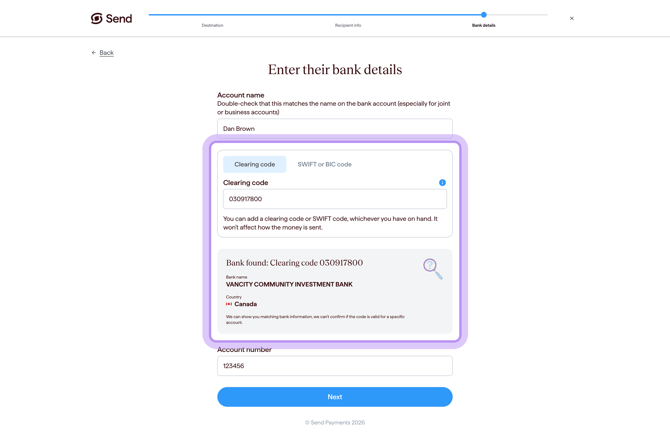
Step 3: Check the codes match
Before continuing, check that the Canadian Clearing Code matches the Canadian Clearing Code given to you by the recipient.
What happens next
When you enter a Canadian Clearing Code on Send:
- Send checks the format. The code must be 9 digits, starting with
0. - If the format is not accepted, check the code with your recipient or their bank before continuing.
- Incorrect or incomplete bank details may delay the payment or cause it to be rejected or returned.
Common questions
I entered the Canadian Clearing Code but the payment was rejected or returned"
A rejected or returned payment can happen for different reasons, including incorrect recipient bank details.
- Double-check the Canadian Clearing Code and the account number with the recipient or their bank.
- If the payment has been returned, contact our support team for help with the next steps.
My Canadian Clearing Code is only 8 digits
A Canadian Clearing Code is 9 digits, starting with a leading 0.
- If the recipient gave you
AAABBBBB(8 digits), add a0at the front to get0AAABBBBB. - If you're still unsure, the recipient can confirm the full code with their bank.
Do I need a Canadian Clearing Code or a SWIFT/BIC for my payment to Canada?
The payment details required depend on the currency and route of your payment.
- For some supported payments to Canada, Send may require a Canadian Clearing Code.
- For other supported payments to Canada, Send may require a SWIFT/BIC instead.
- Send will show you which fields are required when you add the recipient and set up the payment. If you're unsure, contact our support team.
Is the Canadian Clearing Code the same as a Sort Code, ABA, or BSB?
No. Each of those is a different code used in a different country, with a different format and a different field in Send. This article only covers the Canadian Clearing Code. For information on the others, see the related articles below.
Related articles
Other countries use their own routing codes, which are covered in separate help articles:
- Information on SWIFT/BIC numbers
- Clearing Code (Multiple countries)
- Account number (New Zealand)
- ABA codes (United States)
- Sort numbers (United Kingdom)
- How to add a new recipient
Contact us
Call Us
Phone: 1800 982 418
International: +61 7 5619 5700
Hours: 8:30am - 5:30pm AEST/AEDT, Monday - Friday