
What is an ABA routing number?
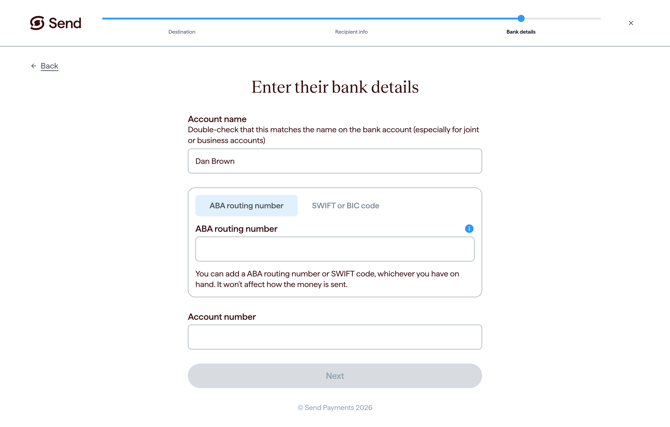
An ABA routing number is a 9-digit code that identifies a bank in the United States.
- It is sometimes called a Routing Number, Routing Transit Number (RTN), Wire Routing Number, or Fedwire Routing Number. They all refer to the same type of code.
- It is similar to a BSB in Australia, but it is only used inside the United States.
- An ABA routing number identifies the bank, not the account. You will also need the recipient's account number.
When do I need an ABA routing number on Send?
It depends on the currency you are sending to your US recipient.
- Sending USD to the United States:
You can enter either an ABA routing number or a SWIFT or BIC code. You only need one of these, not both. - Sending AUD to the United States:
You will be asked for a SWIFT or BIC code and an account number. ABA routing numbers are not used. - Sending EUR to the United States:
You will be asked for a SWIFT or BIC code and an account number. ABA routing numbers are not used.
If you have an ABA routing number but you are sending AUD or EUR, ask your recipient for their bank's SWIFT or BIC code instead. For more information, see Information on SWIFT BIC numbers.
Important: use the wire routing number, not the ACH one
Some US banks have two different routing numbers: one for ACH (used for domestic transfers within the US) and one for wire transfers (used for international payments).
Send sends payments to US banks as international wire transfers, so you need to use the wire routing number.
- The number printed on a US cheque is usually the ACH routing number. It may not work for a wire transfer.
- If you are unsure which one to use, ask your recipient to confirm the routing number their bank uses for incoming international wire transfers.
Before you start
To add a US recipient, you'll need:
- The recipient's full name (or business name).
- The recipient's residential address, including country, city, street, and postal code.
- The recipient's account number.
- One of the following, depending on currency:
- USD: an ABA routing number or a SWIFT or BIC code.
- AUD or EUR: a SWIFT or BIC code
- Any other information shown in Send.
Where your recipient can find their ABA routing number
The best person to confirm the correct ABA routing number is your recipient (the account holder). Ask them to send the details to you directly, and let them know you need the number their bank uses for incoming international wire transfers.
Your recipient can usually find their ABA routing number in these places:
In their online banking
Most US banks show the ABA routing number in the account details section, often under headings such as "Account details", "Receive money", or "International / wire transfers".
On a recent account statement
The ABA routing number is often printed near the bank's name and address on account statements.
On the bank's official website
US banks usually list their wire routing number on their international payments or wire transfer page. Ask your recipient to use their bank's official website rather than a third-party search result.
By contacting their bank
If your recipient still can't find the number, they can contact their bank directly to confirm the routing number to use for incoming international wire transfers.
What happens next
When you enter an ABA routing number on Send:
- An ABA routing number must be exactly 9 digits. If the number entered is invalid, update it before continuing.
- Check the routing number carefully before continuing.
A format check does not confirm that all recipient details are correct or that the account belongs to the recipient.
Incorrect or incomplete bank details may delay the payment or cause it to be rejected or returned.
Common questions
I entered the routing number but the payment was rejected or returned
A rejected or returned payment can happen for different reasons, including incorrect or incomplete recipient bank details.
- Check the routing number, account number, and recipient name with the recipient or their bank.
- If the payment has been returned, contact our support team for help with next steps.
The routing number on my recipient's cheque is different from the one in their online banking
US banks often have two routing numbers: one for ACH (which is the one usually printed on a cheque) and one for wire transfers.
- Send sends payments as international wire transfers, so always use the wire routing number.
- If unsure, ask the recipient to confirm the routing number their bank uses for incoming international wire transfers.
I only have a SWIFT or BIC code, not a routing number
That's fine. For USD payments to the United States, you can enter either an ABA routing number or a SWIFT or BIC code. You only need one of these.
For more on SWIFT/BIC codes, see Information on SWIFT BIC numbers.
Is the ABA routing number the same as a SWIFT code, BSB?
No. They identify different things:
- An ABA routing number identifies a US bank. It is used inside the United States.
- A SWIFT/BIC code identifies a bank internationally.
- IBAN identifies the specific account, used in Europe and many other regions.
- BSB is a domestic code used inside Australia.
For some payments you may need more than one of these together (for example, a SWIFT/BIC together with an account number).
For details on the other codes, see:
- Information on SWIFT BIC numbers
- How to add a new recipient
- Recipients FAQs
Contact us
Call Us
Phone: 1800 982 418
International: +61 7 5619 5700
Hours: 8:30am - 5:30pm AEST/AEDT, Monday - Friday